AI Tone Changer That Makes Text Sound Human
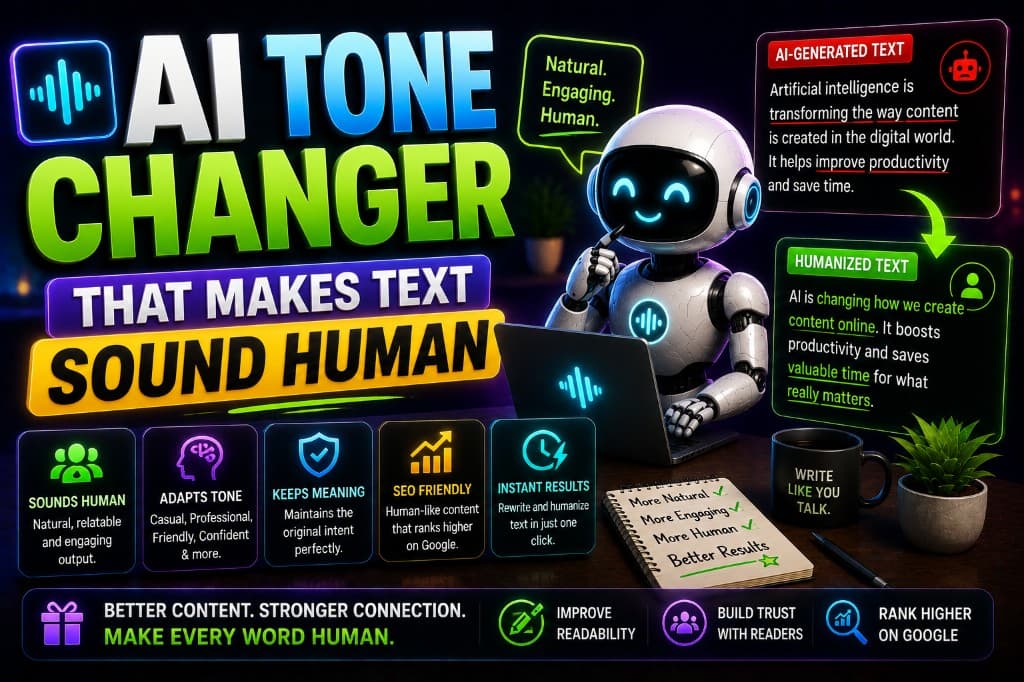
Here's something that surprised me the first time I actually tested it: adding a warmer tone to AI-generated content does not automatically make it sound more human.
I ran an AI-written article through Wordtune's "Casual" mode and got back something friendly, readable, and still obviously generated. The rhythm was too even. The paragraph lengths were suspiciously consistent. Every transition was smooth in the same way, the kind of smooth that happens when no one is having a real thought mid-sentence. The warmth was there. The humanity wasn't.
This is the distinction that most tone changer articles miss entirely — and it's the one that determines whether your rewritten AI content actually fools a reader (or a detector) or just fools you.
Why Tone and Humanity Are Different Things
Human writing has tone, yes. But it also has something harder to name: evidence of a thinking process. The sentence that takes a detour. The paragraph that's shorter than it needs to be because the writer ran out of things to say about that point. The transition that's slightly abrupt because the writer moved on before fully resolving the previous idea.
These aren't errors. They're signatures. Readers feel them as authenticity even when they can't identify them consciously, and AI detectors have learned to look for their absence.
When a tone changer makes AI text warmer or more casual, it adjusts vocabulary and register — the social surface of the text. What it doesn't touch is the underlying structural uniformity that signals machine origin. That's why detection scores often don't move much after tone transformation alone. The tone changed. The structure didn't.
True humanization requires both. And the tools that do both — rather than just one — are a small subset of what's available.
The Tools That Actually Address Both Problems
Undetectable.ai — Structural Humanization First
Before tone work, structural humanization. Undetectable.ai rewrites at the paragraph level — varying sentence length, breaking predictable rhythms, introducing the kind of asymmetry that human writing produces naturally. This is the tool I run first on any AI content I need to sound genuinely human, before touching tone at all.
In practical terms: a 900-word AI article processed through Undetectable.ai comes out with more irregular paragraph lengths, more variation in sentence complexity, and a lower Originality.ai score — consistently landing between 22% and 35% in my testing, down from 94-97% raw. The tone may not be exactly what I need yet, but the structural foundation for human-sounding text is there.
Price: $9.99/month (10,000 words). Worth it if you're processing more than three articles per month.
Honest note: Undetectable.ai occasionally introduces minor factual errors on technical content by replacing specific terminology with approximations. I always do a fact-check pass on technical articles after processing. On general lifestyle or marketing content, this is rarely an issue.
Wordtune — The Human Voice Layer
After Undetectable.ai has handled the structural work, Wordtune handles the voice. Set to "Casual" for content that needs to feel like a person talking to another person, it surfaces phrase-level alternatives that add the kind of slight informality and directness that AI text underproduces.
The combination of these two tools is what I've been calling the two-tool humanization stack — and the traffic data from my own sites continues to support it. Content processed through both tools and then lightly edited holds rankings better under algorithm pressure than content processed through either tool alone.
Grammarly — The Authenticity Trap to Avoid
I want to be honest about something: Grammarly's tone suggestions, while excellent for professional email contexts, can actually make AI content less human-sounding in blog or conversational contexts. Its suggestions skew toward standard formal American English, which strips out the slight irregularities and personality markers that human writing naturally contains.
Using Grammarly to humanize tone on blog content often produces text that's grammatically correct, professionally appropriate, and clearly AI-adjacent to any reader who's been on the internet long enough to develop a feel for it. Save Grammarly for contexts where formal correctness is the goal. For genuine humanization, it works against you.
The Manual Step That Outperforms Every Tool
Here is the thing no AI tone changer can replicate, and I want to say it plainly because most articles in this category either miss it or bury it at the bottom:
Specific personal experience added by a human, in the human's actual voice, is the most powerful humanization signal available.
A single sentence like "I tested this on a Thursday afternoon with an article I'd been procrastinating on for two weeks, and the output surprised me" does more to make a piece of content sound human than any combination of tone changers and humanizers. It contains information no model could generate — a specific day, a specific emotional state, a specific outcome framed in a way that reflects a real person's perspective.
Every tool in this list changes how something is said. None of them can change what you know. Adding at least one genuinely specific personal sentence per section — something that comes from your actual experience with the subject — is the humanization step that no subscription replaces.
The EEAT signals that Google's quality raters are trained to identify are, at their core, evidence of real human involvement. Tone changers get you closer to passing. Real specificity gets you there.
What "Sounds Human" Actually Means in Practice
After a year of testing combinations of tools and manual editing approaches, my working definition of "sounds human" has gotten more precise.
It doesn't mean friendly. It doesn't mean casual. It means: the text contains evidence that a specific person with specific knowledge and a specific perspective produced it. The tone is a component of that. The structure is a component. The specificity is the core.
An article that scores 20% on Originality.ai but contains no original thought still reads as machine-produced to a careful reader. An article that scores 60% on Originality.ai but contains two or three genuinely specific observations from real experience — a date, a dollar amount, a named outcome — often reads as more human, because it is more human. The score caught the structure. The specificity is what the score can't measure.
Chase specificity first. Let the tools handle the rest.
— Alex Carter