AI Content Detector — Free Online AI Text Checker
Paste any piece of writing — an essay, a blog post, an SEO article, an email, or a student submission — and this tool will estimate how closely it resembles the output patterns of large language models like ChatGPT, Claude, and Gemini. You get an overall AI probability score, sentence-level highlights that show which specific lines are driving the score, and a structured breakdown you can act on immediately.
This tool is built for one purpose: giving writers, editors, educators, and publishers a fast, honest first look at whether content was likely AI-generated. It doesn't make accusations. It doesn't issue verdicts. It gives you data — sentence-by-sentence — so you can make informed decisions about what to do next.
No account required. No word limit games. Paste and check.
What an AI Content Detector Shows (and What It Cannot Prove)
AI detectors work by analyzing the statistical patterns in how text is constructed — specifically, two signals called perplexity and burstiness. Perplexity measures how predictable the word sequences are: AI-generated text tends to use high-probability word combinations, producing smoother, more "expected" sentence flows than human writing. Burstiness measures variation in sentence length and complexity: human writers naturally alternate between short punchy sentences and longer, more complex ones. AI output, unedited, tends to be metronomically consistent.
Our detector analyzes these patterns across every sentence in your submitted text and returns a probability estimate — not a binary "AI or human" judgment, but a calibrated score that reflects how strongly the linguistic signals align with LLM output patterns.
What this means in practice:
A high AI probability score (above 80%) means the text closely matches the structural and statistical patterns we associate with ChatGPT-style generation. It doesn't mean the writer didn't write it. It means the writing pattern resembles AI output closely enough that further review is warranted.
A low AI probability score (below 30%) means the text shows the kind of linguistic variation, asymmetry, and unpredictability more typical of human drafting. It doesn't guarantee the content is human-written — a heavily edited AI draft can score low. It means the patterns we're measuring don't raise a flag.
What this tool cannot do:
It cannot prove authorship. No AI detector can. The technology makes probabilistic estimates based on measurable patterns — it doesn't have access to the author's process, their draft history, or their notes. A non-native English speaker writing in a formal register may score higher than expected, because formal academic prose shares structural features with AI output. A heavily prompted, iterated, and manually edited AI draft may score lower than expected, because human editing disrupts the detection signals.
We built this tool to support better decisions, not to replace human judgment. Use the scores to prompt conversation, flag content for deeper review, and inform your editorial or institutional policies — not to issue automatic consequences based on a number alone.
Who Uses CheckAIContent's AI Writing Checker
Educators and academic institutions Teachers, professors, and school administrators use this tool as a first-pass screening layer for submitted essays, assignments, and research papers. Rather than reading every submission with AI suspicion, educators can flag statistically unusual pieces for closer review and direct conversation with the student. The sentence-level highlights are particularly useful in academic settings — they let an instructor point to specific passages and ask the student to explain or expand on them, turning a detection result into a teachable moment rather than an accusation.
Content editors and editorial teams Publishers, content managers, and editorial QA teams use this tool to screen incoming freelance submissions and content agency deliverables before publication. In a media landscape where AI-assisted writing is common and often undisclosed, having a fast screening step in the editorial workflow helps teams maintain transparency standards without manually interrogating every piece. The no-login, paste-and-go workflow is specifically designed to fit into fast-moving editorial pipelines.
SEO writers and content strategists SEO writers who use AI tools as part of their workflow use this detector to measure how "AI-readable" their published content is before it goes live. Google's quality evaluation systems are increasingly sensitive to low-differentiation, high-volume content — running a quick AI check before publishing is a practical QA step that takes 30 seconds and can inform decisions about where manual editing is most needed.
Bloggers and independent creators Independent writers who collaborate with AI tools use this detector to ensure their final published pieces read as distinctly theirs. The sentence-level scoring makes it easy to identify which specific passages still carry AI patterns — and target editing effort where it actually matters, rather than guessing.
HR and compliance teamsHiring teams reviewing writing samples, cover letters, and skills assessments use the detector as one data point in evaluating whether a submission reflects the candidate's actual writing ability. Like all use cases, it's most effective as a flag for further conversation rather than as a standalone decision-making tool.
How to Check for AI-Generated Text (Three Steps)
- 1
Step 1 — Paste or upload your draft
Copy your text directly into the input field. The tool works best on content that's at least 150–200 words — shorter submissions don't provide enough linguistic signal for a stable probability estimate. Full essays, articles, and blog posts (up to the posted character limit) produce the most reliable results. If you're checking a longer document, paste it in sections and review the pattern across each part.
For best results: paste clean text without HTML tags, markdown formatting, or code blocks. The tool is analyzing natural language patterns — non-prose formatting can interfere with signal accuracy.
- 2
Step 2 — Run the AI scan
Click "Check AI Content" and the tool will analyze the full submission in seconds. You'll receive:
- An overall AI probability score — the estimated likelihood that the text was generated by a large language model
- Sentence-level highlights — individual sentences color-coded by their contribution to the AI probability score, so you can see exactly which passages are driving the result
- A structured breakdown of the scoring signals so you can understand what the tool measured and why
The sentence-level view is the most actionable part of the result. A piece with an overall 65% AI probability score that shows three specific flagged sentences is a very different editorial problem from one where every sentence is uniformly flagged.
- 3
Step 3 — Revise, clarify, then publish or submit
Use the highlighted sentences as your editing target. Flagged passages can be rewritten manually, run through our AI Paragraph Rewriter to vary their structure, or reviewed with the Grammar Checker to ensure the final version reads clearly and correctly.
For academic submissions: if content is flagged and the work is genuinely your own, document your research process, note your sources, and be prepared to discuss the flagged passages directly. An AI detector result is the beginning of a conversation, not the end of one.
For publishing workflows: revise flagged passages with added specificity — real data points, named examples, first-person observations. These elements disrupt AI patterns and also improve the quality of the final piece for readers.
Responsible AI Detector Accuracy Expectations
AI content detection is a probabilistic technology, not a forensic one. Understanding what affects accuracy helps you use this tool responsibly and interpret results correctly.
What can shift scores unexpectedly:
Model version differences — Detection models are trained on outputs from specific LLM versions. As ChatGPT, Claude, and other models are updated, their output patterns shift. Our detection model is updated regularly, but there will always be some lag between the latest model releases and detection calibration.
Bilingual and multilingual writers— Non-native English writers who write in a formal academic register often produce text with lower linguistic variation than native speakers writing in the same context. This can produce false positives: human-written text that scores high because its structural patterns overlap with AI output. If you're reviewing work from non-native English speakers, treat high scores with additional context.
Heavily edited AI drafts— A writer who generates a draft with AI and then rewrites 40–50% of it manually will often produce a low detection score. This isn't the detector failing — it's reflecting that the final text genuinely has a high proportion of human-written content. Detection works on patterns in the submitted text, not on the process that produced it.
Very short submissions— Texts under 150 words don't have enough linguistic signal for stable scoring. Short-form content (social captions, taglines, one-paragraph blurbs) should not be evaluated with this tool, as the scores will be unreliable.
How to use results responsibly:
Use AI detector scores as a trigger for further review, not as standalone evidence. In academic contexts, build policies that allow students to explain flagged results and provide evidence of their own process. In publishing contexts, pair detection with editorial judgment about the quality and originality of the content. In hiring contexts, use flagged submissions as an opportunity for a follow-up conversation or live writing task — not as automatic disqualification.
The score tells you what the text looks like statistically. What it means always requires human judgment to determine.
Frequently asked questions
Explore our AI tools
Guides for AI Content Detector
In-depth articles on using AI Content Detector — detection signals, workflows, and publishing best practices.
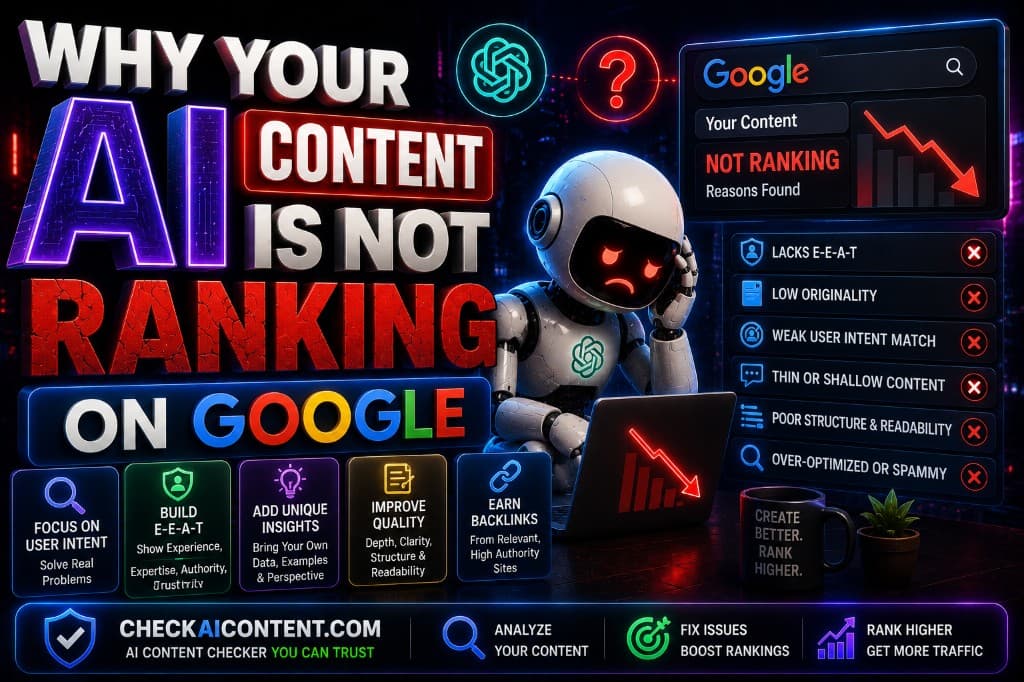
Why Your AI Content Is Not Ranking on Google
Spent months fixing the wrong things. Here's what Google actually changed since 2022 — and the real reasons your AI content isn't ranking, with honest fixes.

ChatGPT SEO Content Strategy: How to Rank AI Content on Google
Tried ranking ChatGPT content and watched it stagnate? Here's the exact workflow I use now — from intent research to author schema — and what I got wrong first.
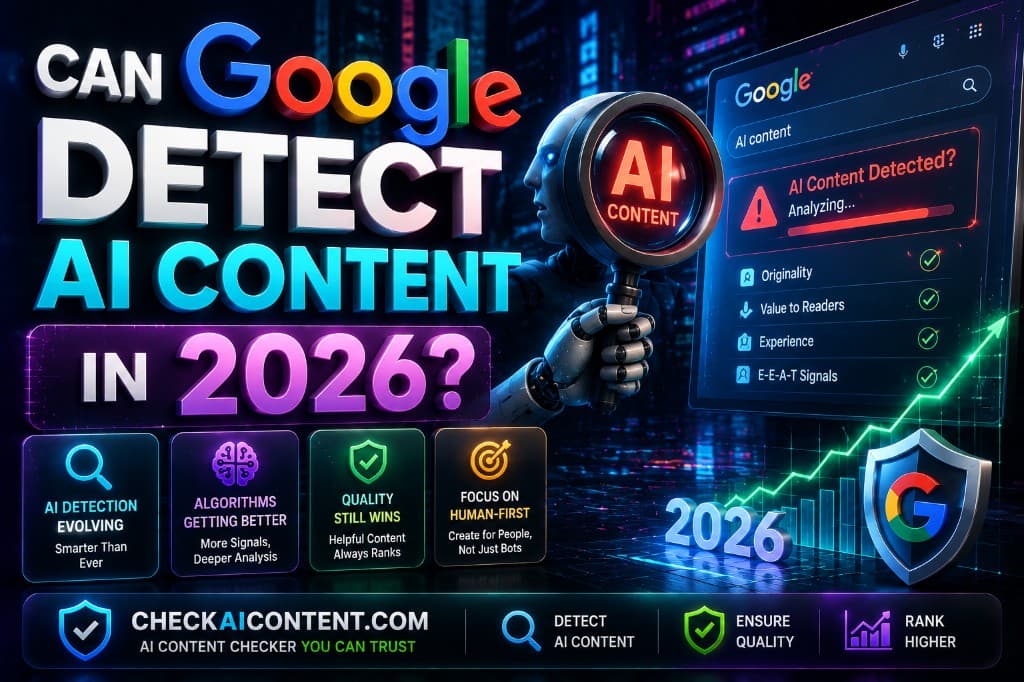
Can Google Detect AI Content in 2026?
Can Google actually detect AI content in 2026? After watching a site lose 64% of its traffic overnight, here's what I learned about how detection really works.
Best AI Humanizer Tools to Bypass AI Detection
Tested 11 AI humanizer tools to see which actually bypass AI detection. Real scores, real pricing, honest verdicts — no affiliate padding.

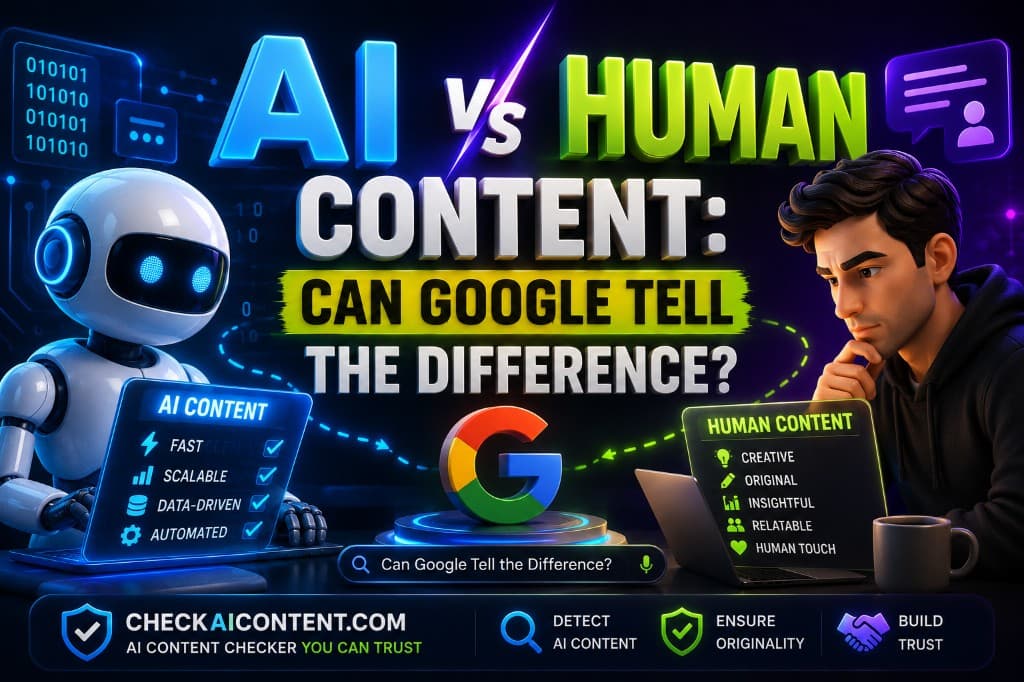
AI vs Human Content: Can Google Tell the Difference?
Can Google actually tell if your content was written by AI? After 16 months of testing AI content vs human content across real sites, here's what the data shows.