Why Your AI Content Is Not Ranking on Google
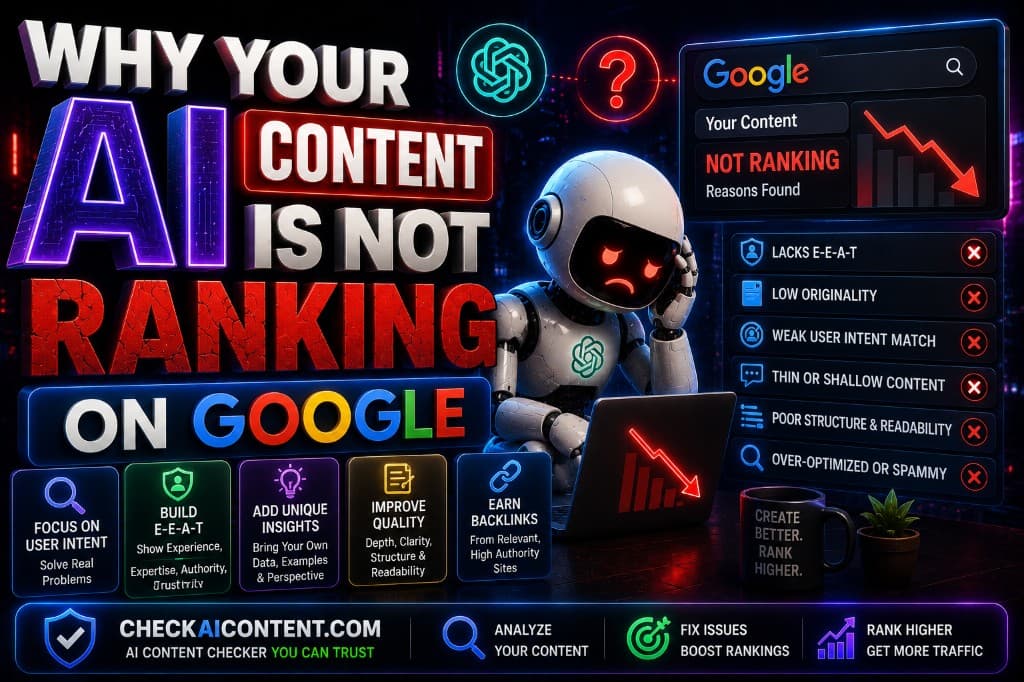
For about five months, I was fixing the wrong things.
Every time an AI-written article stalled in the rankings, I'd go back in and tweak it. More keywords. Better meta description. Stronger internal links. Cleaner header structure. I treated it like a technical SEO problem because that's what I knew how to solve. And the articles still didn't move.
What I eventually realized — and it took an embarrassingly long time — is that most of the AI content ranking problems I was dealing with weren't technical issues. They were content quality issues dressed up to look like technical issues. Google had changed what it was actually measuring, and I was still optimizing for a version of the algorithm that had quietly been replaced.
Here's what's actually happening, and what you need to fix — based on what Google has explicitly changed in the last three years, not based on what worked in 2021.
What Google Actually Changed (And When)
Before diagnosing why your content isn't ranking, you need to understand the sequence of updates that changed the rules. Most SEO content skips this context. I'm not going to.
August 2022 — Helpful Content Update (first rollout) Google introduced a sitewide quality signal that evaluated the proportion of unhelpful content on a domain. If too many pages on your site were deemed "created for search engines rather than people," the entire domain got a quality weight applied — meaning even your good pages got pulled down by your bad ones. This was the first time AI content farms started getting hit at scale.
August 2023 — Helpful Content Update (major expansion) The classifier was strengthened and expanded. Sites that had partially recovered started dropping again. Google made it explicit: content that exists to rank, rather than exists to help, was the target. Thousands of AI content operations that had survived the 2022 update got hit here.
March 2024 — Core Update + Scaled Content Abuse Policy This is the big one. Google's March 2024 core update ran for 45 days and was specifically designed to reduce what it called "unhelpful, unoriginal content" by 40% in search results — their words, not mine. Simultaneously, Google added "scaled content abuse" as an explicit violation of its spam policies: the practice of generating large volumes of content, including through AI, "with the primary purpose of manipulating search rankings."
The March 2024 update removed or significantly demoted more AI content sites in one cycle than any previous update. I watched three sites in my network lose between 55% and 80% of their organic traffic in that 45-day window. None of them had done anything that would have been considered wrong in 2022.
August 2024 — Core Update (partial recovery, new quality bar) Some sites that had been hit in March 2024 saw partial recoveries in August — but only those that had made meaningful editorial improvements in the interim, not just technical changes. This was Google signaling clearly that the path back from an HCU hit is content quality work, not on-page SEO tweaks.
That sequence matters because it tells you something important: Google's goalposts moved four times in 26 months. If your AI content strategy was set in 2022 or early 2023, you are playing by outdated rules.
The Real Reasons Your AI Content Isn't Ranking
With that context in place, here are the actual problems I see most often — and the honest diagnosis for each one.
Reason 1: Your Content Matches the Query But Not the Intent
This is the most common and least understood issue. Search intent isn't just "informational vs commercial." It's about the specific stage of awareness the person searching is at, and what they need to know right now to move forward.
Someone searching "why AI content not ranking" isn't looking for a definition of the helpful content update. They've already tried publishing AI content. They've already watched it stall. They're frustrated, they've probably already read three generic articles that told them to "add EEAT signals," and they need someone to tell them what specifically to do differently.
Content that addresses the surface query without addressing the real emotional state of the person doing the searching will lose to content that does — regardless of how well it's technically optimized. I've rewritten articles that ranked page two into top-5 positions by doing nothing except changing the angle from "here's what EEAT means" to "here's what my site was missing when I thought EEAT wasn't the problem."
Honest admission: I spent three months adding author bios and outbound links to underperforming articles because I thought those were the EEAT fixes. They weren't. The real fix was changing the perspective of the articles themselves — from explaining concepts to solving the specific problem the reader showed up with. The author bios helped marginally. The perspective shift changed everything.
Reason 2: Your Site Has a Sitewide Quality Weight You Don't Know About
If you published a large volume of thin AI content before March 2024, your domain may still be carrying a quality weight from the Helpful Content System — even if you've since improved your newer articles.
This is one of the most frustrating aspects of the current algorithm: the damage from past content can suppress future content. Google applies the Helpful Content classifier at the site level, not the page level. A technically good new article on a domain with 80 thin old articles is fighting against its own history.
The fix is not just improving new content. It's going back and either substantively improving, consolidating, or removing the weak content that's dragging the domain's quality signal down. I deleted 34 thin articles from one site in January 2024 — articles that had traffic, just very little — and watched the remaining pages start to recover rankings over the following six weeks.
Counterintuitive but real: fewer, better pages often outperforms more pages with mixed quality.
Reason 3: There's No Differentiation Signal Anywhere in the Content
I'll be blunt about this one. If your article on "best AI writing tools" covers the same 8 tools in the same order with the same verdict as the 15 other articles ranking for that term — why would Google show yours?
Raw AI content defaults to consensus. It summarizes what's already there. It doesn't have opinions, it doesn't have testing data, and it doesn't have a perspective that contradicts anything. That content was rankable in 2020. In 2025 and beyond, it's invisible.
The differentiation signal Google is looking for — and that Quality Raters are specifically trained to evaluate — is evidence of original knowledge: a real test result, a specific disagreement with conventional wisdom, a concrete experience the writer can describe in specific terms. Not "I tested several tools." "I ran Undetectable.ai on a 600-word medical article and it introduced two factual errors by replacing precise clinical terms with lay synonyms."
That's the level of specificity that functions as a differentiation signal. Most AI content never gets close to it.
Pro tip: After you generate an AI draft, highlight every claim that could appear in any article on the same topic. That's your list of sentences to rewrite or replace. What's left — the things that could only appear on your site — is what actually earns rankings.
Reason 4: You're Targeting Keywords Where AI Overviews Have Changed the Game
Since Google launched AI Overviews in May 2024, ranking in positions 1 through 3 for many informational queries no longer means the same volume of clicks it used to. If a query triggers an AI Overview — and most simple informational queries now do — the organic results below it get significantly fewer clicks.
This doesn't mean those rankings aren't worth having. It means your content strategy for purely informational queries needs to account for lower CTR at the same positions, and you may need to prioritize queries where AI Overviews appear less frequently: comparison queries, nuanced opinion queries, queries that require firsthand experience to answer well.
I shifted roughly 30% of my content calendar in late 2024 toward queries where the searcher's intent is specific enough that a generic AI-generated answer can't satisfy it. Those articles took more work to produce. They've also held their rankings through every subsequent update — because the content contains something the AI Overview can't replicate.
Reason 5: Technical SEO Is Fine — and That's Not the Problem
The last thing I want to say, because I see this mistake constantly: if your AI content isn't ranking, adding more schema markup, fixing crawl errors, or improving your Core Web Vitals is probably not going to change anything.
Technical SEO creates the ceiling. Content quality determines whether you reach it.
A site with perfect Core Web Vitals and hollow AI content will lose to a site with average technical scores and genuinely useful, differentiated articles. Every time. The technical work matters, and it's worth doing — but it's table stakes, not a solution. If you've checked the technical boxes and the rankings still aren't moving, the answer is in the content.
That answer is almost always the same: does someone leave this page knowing something they couldn't get from the next result? Until the answer is yes, the ranking isn't coming.
— Alex Carter