Best AI Tone Changer Tools in 2026
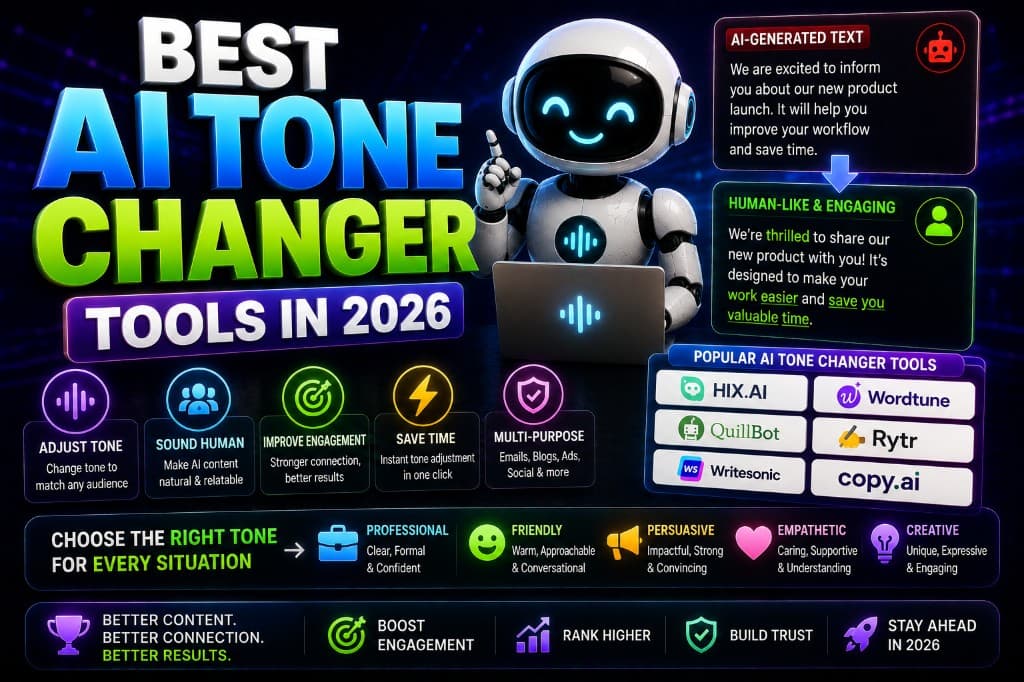
It was a Tuesday afternoon and I was staring at a product description I'd written in what I can only describe as "tired academic." Complete sentences. Accurate. Bloodless. The kind of copy that makes a person feel informed and completely unmoved at the same time.
The client needed it to sound warm, slightly conversational, like a knowledgeable friend recommending something — not a brochure. I had 40 minutes before a call. I didn't want to rewrite it from scratch.
I pasted it into Wordtune, selected "Casual," and got back something that was genuinely better in under two minutes. Not perfect — a couple of lines needed manual adjustment — but the core problem was solved faster than I expected. That afternoon was when I started actually paying attention to AI tone changers as a category, rather than treating them as a novelty on the side of writing tools I already used.
A year of testing later, here's the honest picture.
What AI Tone Changers Actually Do (and Don't Do)
Tone, in writing, is a combination of word choice, sentence rhythm, formality level, and the implied relationship between writer and reader. Changing it isn't just swapping vocabulary — it's restructuring how information is delivered and who it's presumed to be talking to.
The best AI tone changers understand this at a structural level. The weaker ones do vocabulary swaps and call it done. The gap between those two approaches is significant enough that choosing the wrong tool for a professional context can produce output that's worse than your starting point.
What no AI tone changer can do — worth stating clearly — is add content that isn't there. If your original draft is vague, a tone change produces vague content in a different register. The tools here change how something is said, not what is said. Keep that distinction in mind as you choose.
Wordtune — Best Overall for Tone Control
Price: Free (10 rewrites/day). Individual: $9.99/month or $6.99/month annually.
Wordtune earns the top spot because of how it handles tone adjustment: not as a single transformation, but as a set of phrase-level alternatives you can selectively apply. When I changed that product description from formal to casual, I wasn't accepting a wholesale rewrite — I was choosing, sentence by sentence, which phrasing fit best.
That control matters enormously for professional content. A press release that needs to be "warmer" can't just have every sentence replaced — specific parts need to stay formal while others become more human. Wordtune's granular approach is the only free-tier tool that handles this nuance well.
Tested on a 400-word formal report: the casual mode produced output that needed about 15% manual adjustment before I'd use it in a real deliverable. That's genuinely good performance.
Personal insight: I use Wordtune's "Formal" mode for client emails where I've written something that's technically correct but comes across as terse or cold. Ten seconds of processing, one or two accepted alternatives, and the email reads more professionally. It's one of those micro-uses that saves a surprising amount of social friction over the course of a week.
Grammarly Tone Detector + Rewriter — Best for Professional Contexts
Price: Free (basic). Premium: $12/month annually, $30/month monthly.
Grammarly's approach to tone is different from every other tool in this list: it detects your current tone before suggesting changes. The Tone Detector reads your draft and labels it — "Confident," "Formal," "Friendly," "Worried" — and that feedback alone is often useful before any rewriting happens.
The Premium rewriting features let you set a target tone and get inline suggestions for how to move toward it. For professional writing — emails, proposals, reports — this is the most polished experience available. The suggestions are conservative enough that you're unlikely to accept something that sounds wrong.
What Grammarly doesn't do well: creative or casual content. Its training skews heavily toward standard American professional English, which means suggestions for blog content or conversational copy can feel stiff. I use it for professional context work and switch to Wordtune for everything more informal.
The free tier's tone detection is genuinely useful on its own — it's worth using even if you don't subscribe, just to audit what register your draft is actually landing in before you decide if changes are needed.
QuillBot Tone Modes — Best for Speed
Price: Free (125 words per paraphrase). Premium: $9.95/month or $4.17/month annually.
QuillBot's tone selection — Standard, Fluency, Formal, Creative, Shorten, Expand — isn't as nuanced as Wordtune's phrase-level control, but it processes content significantly faster and with less friction. For bulk content work where speed matters more than surgical precision, it's the most efficient option.
The "Formal" mode is its strongest. In my tests, formal-to-casual conversion was less reliable — QuillBot sometimes oversimplifies to the point of losing professional credibility. For anything where the output needs to sound specifically casual or conversational, Wordtune produces better results. For formal tightening and professional polish, QuillBot is faster and equally good.
Jasper AI — Best for Marketing Copy
Price: Starts at $39/month (Creator plan).
Jasper is overkill as a tone changer if that's all you need it for. At $39/month, the cost only makes sense if you're using it as a full AI writing platform — which is what it's actually built for. But the tone control features within Jasper are genuinely excellent for marketing contexts: the tool understands brand voice, can apply a consistent tone across multiple pieces, and produces output at a level of polish that justifies the higher price for high-volume marketing teams.
For individual bloggers or students, it's not the right tool. For a content team producing product copy, email sequences, and landing pages at scale, the tone consistency Jasper offers across all of those outputs has real value.
The Honest Ranking
For most people reading this: Wordtune for precision, QuillBot for speed, Grammarly for professional polish. All three have free tiers worth testing before committing to a subscription.
The one thing none of them replace is knowing what tone you're targeting before you start. "Make this sound better" is not a tone instruction. "Make this sound like a knowledgeable colleague explaining something to a peer, not a manager writing a policy memo" — that's a tone instruction. The clearer you are about the register you're moving toward, the better every tool in this list performs.
— Alex Carter