ChatGPT vs AI Paragraph Rewriters: Which Is Better?
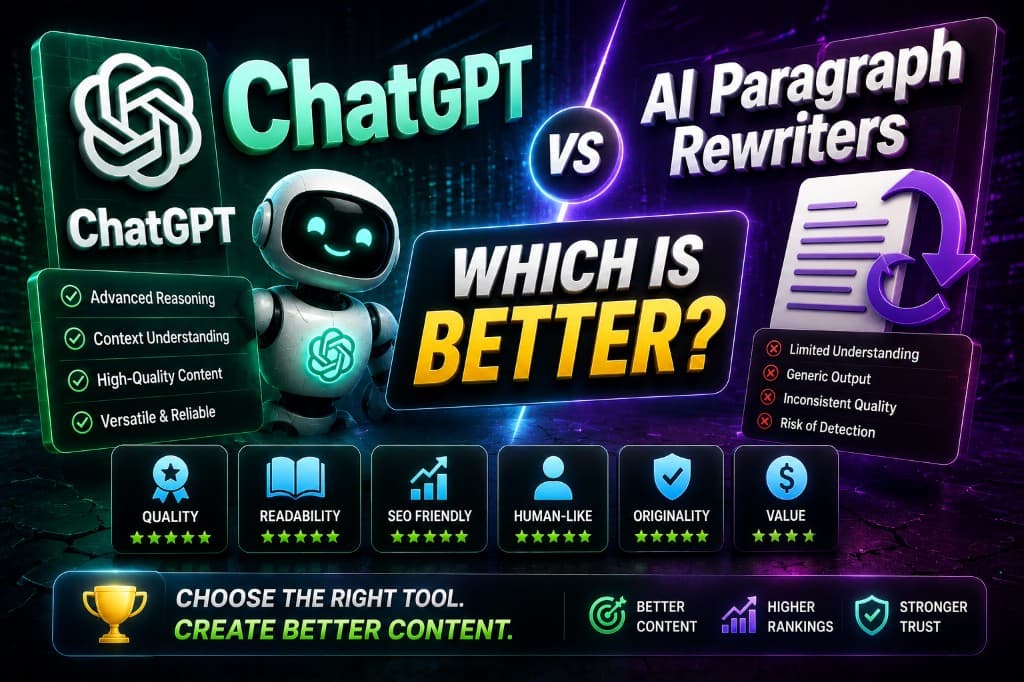
Seven minutes. That's how long it took me to process a 900-word AI-generated draft through Undetectable.ai, do a manual voice pass, and have a publishable article — compared to 43 minutes using ChatGPT to rewrite the same draft iteratively, prompt by prompt, until I got output I was satisfied with.
Both results were good. One took six times longer to produce.
That timing gap is the reason I now reach for a dedicated rewriting tool before I ever open a new ChatGPT conversation — and it's also why the answer to "which is better" isn't what most comparison articles will tell you. ChatGPT is more powerful. Dedicated AI paragraph rewriters are more efficient. Which one you need depends entirely on what you're actually trying to accomplish, and most people conflate the two use cases in ways that cost them real time.
What ChatGPT Is Actually Good At (For Rewriting)
Let me give ChatGPT its honest credit, because it earns it in specific scenarios.
When you're rewriting content that requires meaningful restructuring — not just freshening the prose but rethinking the angle, changing what the article leads with, or adding a layer of nuance the original missed — ChatGPT is genuinely better than any dedicated rewriting tool. You can have a conversation with it. You can say "the third section is logically weak, here's why, rewrite it with this angle instead." You can push back on output you don't like and get a refined version within seconds.
I use ChatGPT for that kind of structural rewriting — the editorial decisions that require judgment, not just processing. When a client's AI draft has a fundamentally wrong framing for its target audience, no rewriting tool fixes that. ChatGPT can, if you direct it with enough specificity.
The downside: it requires skill and time to prompt effectively. Vague instructions produce vague output. Getting genuinely good rewritten content from ChatGPT means writing prompts that describe the problem precisely, evaluating the output critically, and iterating until the result is right. That 43-minute session I mentioned wasn't poor prompting — it was what careful prompting actually takes.
Personal observation: The people I see getting frustrated with ChatGPT rewriting are almost always using it for jobs it isn't efficient at — processing large volumes of content that doesn't need editorial rethinking, just surface-level humanization. That's not ChatGPT's job. That's a rewriting tool's job.
What Dedicated AI Paragraph Rewriters Are Good At
Dedicated rewriting tools — Undetectable.ai, QuillBot, Wordtune, HIX Bypass — are built for one specific job: transforming AI-generated text into text that reads differently, scores differently on detectors, and requires minimal editorial input. They do that job faster and more consistently than ChatGPT because they're not general-purpose.
The key difference is how they handle the input. ChatGPT treats your draft as a starting point for generating something new. A dedicated rewriter treats your draft as a structure to preserve while changing its surface features — rhythm, vocabulary range, sentence length variation, paragraph transitions. The underlying meaning and sequence of information stays intact. Only the expression changes.
That constraint is actually an advantage in most rewriting scenarios. When you've spent time building keyword structure, internal links, and information hierarchy into an AI draft, you don't want a rewrite that reorganizes all of it. You want a rewrite that keeps the structure and changes the prose. Dedicated tools do exactly that. ChatGPT, even when instructed not to restructure, often does anyway.
Side-by-Side: The Same Paragraph, Both Approaches
Original AI-generated paragraph (Originality.ai score: 96%): "AI content rewriting tools offer a variety of features that can help content creators improve the quality of their articles. These tools use advanced algorithms to paraphrase and restructure text, making it more suitable for human readers and search engine optimization purposes."
After ChatGPT (prompt: "Rewrite this to sound more natural and human"): "If you're creating content with AI, rewriting tools can be a real asset. They're designed to reshape your text so it reads more naturally — which matters both for your audience and for how Google evaluates the content."
Better. Still a bit generic. ChatGPT took it in a slightly different direction — added the Google angle, which wasn't in the original. That's useful in some contexts, a problem in others if you needed to preserve the exact scope.
After Undetectable.ai + 3 minutes of manual editing: "Most AI-generated paragraphs share a fingerprint: long compound sentences, passive constructions, a slightly formal register that no actual person uses in casual writing. Dedicated rewriting tools are built to disrupt that pattern — varying sentence length, shifting vocabulary, breaking the predictable rhythm that detectors and readers both pick up on."
Originality.ai score after: 18%. Different in character from both the original and the ChatGPT version. More specific, more opinionated, with a clear point of view. That specificity came from my manual pass, not the tool — but the tool created the structural foundation for it.
The Honest Comparison Table
| ChatGPT | Dedicated Rewriter | |
|---|---|---|
| Speed for bulk rewriting | Slow | Fast |
| Handles structural rethinking | Yes | No |
| Preserves original structure | Inconsistent | Reliable |
| Detection bypass | Inconsistent | More reliable |
| Requires prompting skill | Yes | Minimal |
| Cost | $20/month (Plus) | $9.99-$24.99/month |
| Best for | Editorial rewrites | Surface-level humanization |
When to Use Which
Use ChatGPT when:
- The draft has a fundamental framing problem that needs editorial rethinking
- You need to change the target audience mid-article
- The content requires nuance or correction that a word-swap tool can't add
- You have time to iterate and the quality ceiling matters more than speed
Use a dedicated rewriter when:
- You're processing a high volume of content that's structurally sound but reads as AI-generated
- You need consistent detection score reduction without a 40-minute prompting session
- The keyword and information structure of the original needs to be preserved
- You want a repeatable, time-efficient workflow rather than a creative process
The mistake I made for the first year of working with AI content was treating these two tools as interchangeable. I'd use ChatGPT for everything and wonder why my workflow was slow. Then I'd use a rewriting tool for something that needed genuine editorial judgment and wonder why the output was shallow.
They solve different problems. As I detailed in the SEO content strategy that actually moves rankings, understanding which tool belongs at which stage of the process is the difference between a workflow that scales and one that consumes your whole afternoon for three articles.
Use both. Use them for the right jobs. The 43 minutes vs 7 minutes comparison at the start of this article isn't an argument against ChatGPT — it's an argument for keeping it in its lane.
— Alex Carter