Free AI Tone Changer for Professional Writing
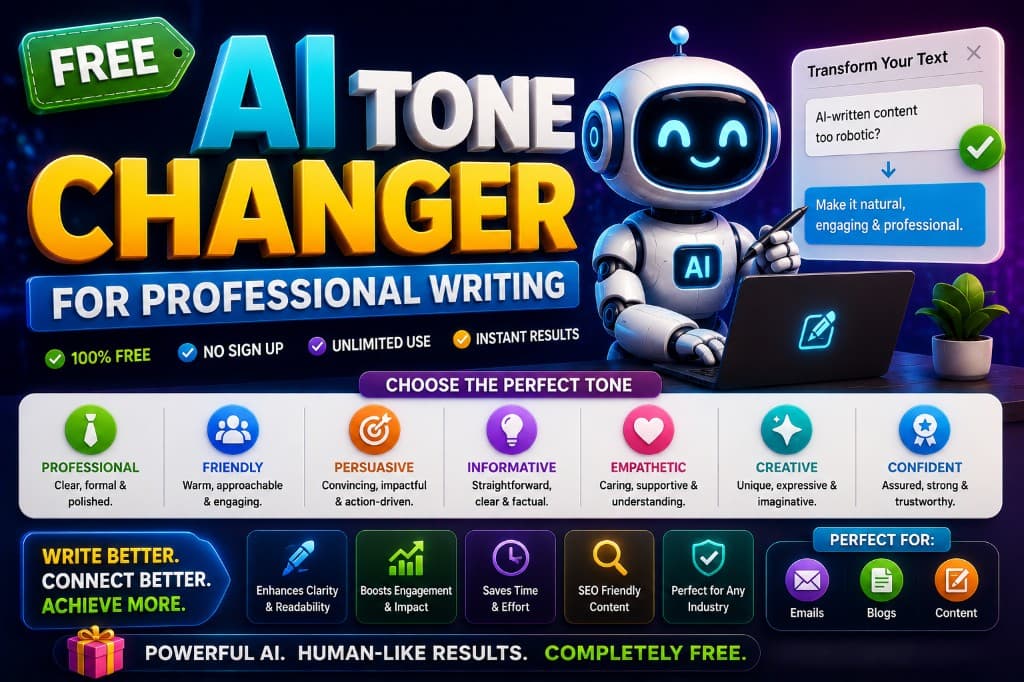
Before: a perfectly accurate project update email that read like a passive-aggressive performance review. After: the same information, same length, delivered in a tone that wouldn't make anyone defensive before the meeting it was previewing.
The tool I used cost nothing. The fix took four minutes.
I mention this because "free AI tone changer" gets searched by people who've been burned by paywalled features before — who've found a tool, started using it, hit a wall at exactly the moment they needed it most, and closed the tab. That frustration is real. So is the fact that several genuinely useful free options exist in this category, with honest limitations worth understanding before you commit time to any of them.
Here's what the free tier actually gives you across the tools that matter — and where each one stops short.
Grammarly Free — Best Free Option for Professional Tone
Free tier: Tone Detection, basic writing suggestions, style feedback.
Grammarly's free plan includes the Tone Detector, which is the most underused free feature in professional writing tools. Paste any draft email or document and it returns a tone label — "Confident," "Formal," "Worried," "Friendly," "Disapproving" — based on the language patterns in your text.
That diagnostic alone, without any paid rewriting features, changes how many professional writers work. Knowing that an email you intended to read as "direct and clear" is actually registering as "terse and slightly hostile" gives you the information to fix it yourself, without needing AI suggestions at all. The Tone Detector is a mirror, not a rewriter — and for professional writing, mirrors are often more useful than rewrites.
What the free tier doesn't give you: the inline rewriting suggestions that rephrase specific sentences toward your target tone. Those are a Premium feature ($12/month annually). The free version tells you what your tone is. The paid version helps you change it.
How I actually use it: I run every client-facing email through Grammarly's free Tone Detector before sending, specifically to catch the gap between my intended register and the one actually on the page. Emails I write when I'm pressed for time tend to read as "urgent" with undertones of "impatient" — not the impression I want a client to have. Catching that before send costs me 30 seconds. Not catching it sometimes costs me a conversation.
Wordtune Free — Best Free Option for Content and Blog Writing
Free tier: 10 rewrites per day, no account required initially.
Ten rewrites per day is enough to solve a real problem if the problem is contained — a blog introduction that isn't landing, a product description that sounds flat, an email paragraph that's technically correct but tonally wrong. For a single piece of content that needs a tone adjustment in one or two sections, the free tier delivers.
The limitation is volume. Ten rewrites covers one focused editing session, not a full article workflow. For anyone producing more than two or three pieces of content per week that need tone adjustment, the free tier becomes a bottleneck quickly. The paid plan at $6.99/month (annual) is the realistic option for consistent professional use.
What the free tier handles well: casual-to-professional and professional-to-casual shifts. Wordtune's two clearest modes are "Casual" and "Formal," and both work reliably in the free tier. For anyone who only occasionally needs to adjust writing register — a professional who writes one important email per week, a student who edits one assignment at a time — the free limit is workable.
QuillBot Free — Best Free Option for Volume Processing
Free tier: Unlimited paraphrasing, capped at 125 words per paraphrase.
The 125-word cap is genuinely frustrating for long-form content. For professional writing — where the pieces are often shorter than blog posts — it's more manageable. A 300-word formal email can be processed in three pastes. A 500-word client brief in four or five.
The tone modes in the free tier are limited: Standard and Fluency are available without a subscription, while the more useful Formal and Creative modes require Premium. For professional writing specifically, that's a meaningful limitation — Formal mode is where QuillBot performs best for this use case, and it's behind the paywall.
What the free tier delivers for professional writing: fluency improvements and sentence-level cleanup. Not true tone changing, but useful for making drafts read more smoothly without altering their register significantly.
LanguageTool Free — Underrated for Formal Register
Free tier: Generous — style and grammar checks across multiple languages.
LanguageTool doesn't market itself primarily as a tone changer, but its style suggestions for formal writing are among the most useful free features in this category. It flags passive constructions, wordiness, informal register in formal contexts, and overly complex sentence structures — all of which are components of tone.
For non-native English speakers writing professional content, LanguageTool's free tier often outperforms the other tools in this list for maintaining appropriate formal register. It's less "change this tone" and more "this tone is off in these specific places" — which, for professional writing, is often the more useful intervention.
It also supports 30+ languages in the free tier, which makes it the only tool here with real utility for professional writing outside of English.
The Honest Limit of Every Free Tier
Here's what none of these free tiers give you: the combination of precise tone control, unlimited volume, and consistent output quality that professional writing at scale actually requires.
The free tools in this category are diagnostic and occasional-use tools. For someone who writes one or two professional pieces per week and needs occasional register adjustment, they're genuinely sufficient. For a copywriter, content manager, or communications professional producing ten or more pieces per week — the paid tiers pay for themselves in time.
The calculation I use: if I spend more than 15 minutes per week fighting with free-tier limitations (resetting paraphrase counts, splitting content into 125-word blocks, losing context between passes), the $6-12/month for a paid subscription is worth it. Under that threshold, free is fine.
What the free tier can never give you is the most important thing in professional writing: knowing exactly what you want to say and having the language to say it. That's a thinking problem, not a tool problem. Every tool in this list helps you express something better. None of them help you figure out what that something should be.
Know what you want to communicate. Then let the tools help you say it in the right register.
— Alex Carter