How AI Grammar Checkers Improve Your Writing
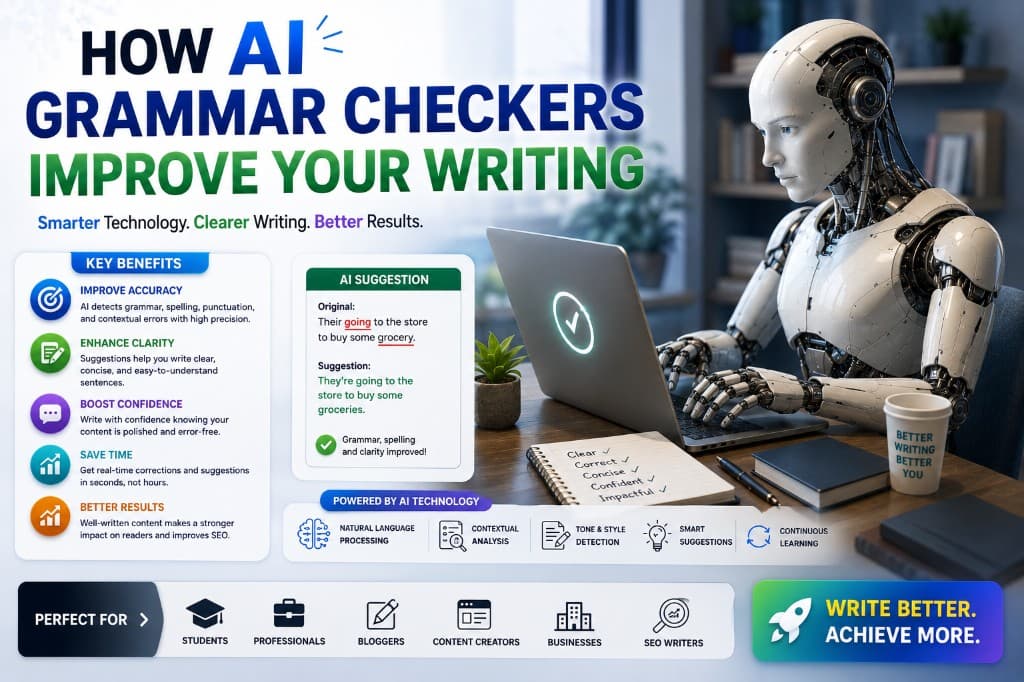
I still remember the first time I ran my own writing through ProWritingAid's full analysis. I had been writing online for four years at that point. I had a growing audience. I had people emailing me saying my writing was clear and engaging.
The report said my average sentence length was 24.3 words — eight words longer than the recommended ceiling for readability. My passive voice usage was at 18% — ProWritingAid flags anything above 10% as a potential concern. And I had 34 "sticky sentences" in a 2,100-word piece — sentences loaded with filler phrases that were slowing the reader down without adding meaning.
I sat with that report for a while. Not in a productive, reflective way. In the way you sit with something when you don't want to accept what it's telling you.
Then I rewrote the piece using the suggestions, posted the new version, and watched the average time-on-page increase from 2:43 to 4:11 over the following two weeks. The grammar was fine in the original. The writing was the problem.
The Difference Between Catching Errors and Improving Writing
Grammar checkers started as spell-checkers with extra steps. The early tools caught the obvious — missing apostrophes, double spaces, wrong homonyms. Useful, but limited. The improvement in your writing was proportional to how many surface errors you'd been making.
Modern AI grammar tools have moved well beyond that. The best of them are analyzing writing at the structural level: sentence rhythm, vocabulary variety, passive vs active constructions, paragraph pacing, clause complexity. These aren't grammar issues in the traditional sense. They're clarity and readability issues — the difference between writing that's technically correct and writing that a reader can move through without friction.
That shift is what makes the category genuinely valuable for writers who think they've moved past basic error correction. The errors the best tools catch aren't in your spelling. They're in how you've trained yourself to write — the habits that feel natural and produce output that's subtly harder to read than it should be.
The Specific Ways These Tools Change Your Writing
They surface patterns you can't see from inside them.
When you're writing, you can't see your own sentence length distribution. You don't notice that you've opened six consecutive paragraphs with "The" or "This." You don't feel the rhythm monotony that a reader feels when your sentences become consistently similar in length.
Tools do. And once they've shown you a pattern twice, you start catching it yourself — which is where grammar checkers do their most lasting work. The tool's value isn't just in the corrections it makes to a single document. It's in the patterns it teaches you to see across all your future writing.
I stopped using passive voice as a default construction about six months into regular ProWritingAid use. Not because the tool was correcting me every session, but because it had corrected me often enough that I started catching it in real time, while writing, before the suggestion appeared.
The moment I noticed the change: I was writing a client email — nothing I'd normally run through any tool — and I wrote "the proposal was reviewed by the team" and immediately changed it to "the team reviewed the proposal" without thinking. Muscle memory. ProWritingAid had built the habit in me without me planning to build it. That's worth more than any single correction.
What Grammar Checkers Catch That Human Proofreaders Often Miss
Human proofreaders are excellent at catching errors that disrupt meaning. Missing words, wrong homophones, sentences that don't complete their thought. They're less reliable at catching errors that don't disrupt meaning but do slow reading or undermine credibility.
Grammar checkers in 2026 catch several categories in this second group with high consistency:
Hedging language — "It seems like," "perhaps," "somewhat," "might possibly" — that weakens confident claims. Grammarly's delivery suggestions flag this specifically. A sentence that says "this might be a useful approach" reads as less credible than "this approach works because..." even though both are grammatically correct.
Redundant phrases — "in order to" (just "to"), "due to the fact that" (just "because"), "at this point in time" (just "now"). Every experienced writer has two or three of these they default to without noticing. Grammar tools catch them every time.
Inconsistent terminology — using "AI content," "AI-generated content," and "content written by AI" to mean the same thing within a single piece. Human readers experience this as a small clarity tax. ProWritingAid's consistency report catches it explicitly.
The Honest Limit: What They Don't Catch
Grammar checkers, even the best ones, don't understand what you're trying to say. They understand how you've said it.
A sentence can be grammatically impeccable, perfectly clear, stylistically consistent — and completely wrong for the argument it's meant to support. A paragraph can flow beautifully and make a factual error that no grammar tool will ever flag. A piece can pass every readability metric and fail to answer the question the reader actually came with.
These are the problems that require human judgment — the kind of judgment that comes from understanding the reader, the topic, and the purpose of the piece simultaneously. Building that kind of quality into AI-assisted content is a different challenge from catching grammar errors, and no tool solves it mechanically.
The best mental model for AI grammar checkers is this: they handle the technical floor of writing quality. They catch what precision and habit can catch. They make you a more disciplined writer over time by exposing your patterns.
What they don't do — what nothing does automatically — is raise the ceiling. That ceiling is determined by how well you understand your subject, your reader, and what the piece actually needs to say. Grammar tools get you to the floor faster. The ceiling is still yours to build.
Starting Point If You're New to These Tools
If you've never used an AI grammar checker systematically, start with the free version of Grammarly for two weeks before considering any paid option. Run every piece of writing you produce through it — emails, blog posts, social captions, anything. Don't just accept suggestions; read the explanations.
After two weeks, you'll know which categories of errors you make consistently. That pattern is your roadmap for which paid features, if any, are worth the investment for your specific writing habits. Someone who writes passive voice constantly benefits most from ProWritingAid's passive voice reporting. Someone whose main issue is wordiness benefits most from Hemingway. The tool that helps you most is the one that catches what you get wrong — not what grammar checkers are theoretically capable of catching.
The 34 sticky sentences in that piece four years ago embarrassed me. They also made my writing measurably better. That's a trade I'd take again.
— Alex Carter