How to Rewrite AI Content Without Losing SEO Rankings
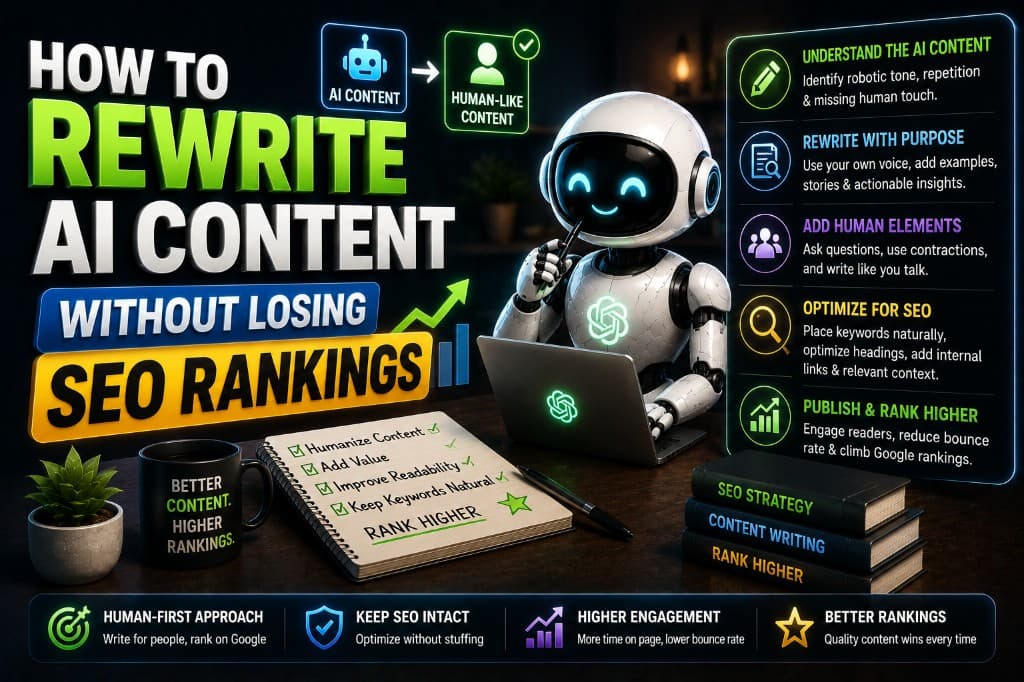
Picture this: a blogger named Sarah spent three months building a content cluster — 14 articles on AI writing tools, all AI-generated, all published without heavy editing. In February 2024, she was pulling 8,400 organic sessions a month. By April, after the March core update finished rolling out, she was at 2,100. She messaged me asking what to do. Her first instinct was to delete everything and start over.
That instinct was wrong — and acting on it would have made things worse.
I've seen this play out more than once. The panic after a ranking drop leads to decisions that destroy whatever authority the domain had built, rather than decisions that rebuild it methodically. Here's the approach I actually recommended to Sarah, the reasoning behind each step, and what happened afterward.
Q: Should I delete all my AI content after a ranking drop?
No — and do not do this without a clear audit first.
Deleting content removes pages that may have backlinks, internal link equity, and indexed URLs that other pages rely on for topical context. I've seen bloggers delete 60% of their site in a panic and watch their remaining pages also drop, because the internal linking structure that had been supporting them disappeared overnight.
The right question isn't "should I delete it?" It's "which specific pages are hurting my domain's quality signal, and what's the least destructive way to address them?"
Start with Google Search Console. Filter for pages with impressions but near-zero clicks over the last 90 days — these are the pages Google is showing but users aren't choosing, which signals low relevance or quality. These are your first candidates for improvement or consolidation, not deletion.
Sarah had 14 articles. After the audit, 4 were performing adequately and worth protecting. 6 needed substantive rewrites. 4 were genuinely thin — under 500 words, low specificity, not ranking for anything meaningful — and those were consolidated into two stronger articles.
Q: How do I rewrite AI content without destroying its existing SEO structure?
Work with the structure, not against it.
The existing article's H2/H3 structure, internal links, and keyword placement are assets — even in underperforming content. When you rewrite, keep the heading structure intact unless it's genuinely wrong for the topic. Keep the internal links. Keep the slug and URL.
What you're replacing is the substance, not the scaffolding.
For each section under a heading, ask: does this paragraph contain anything that couldn't appear in any other article on this topic? If the answer is no, that paragraph needs to be rewritten with something specific — a real example, a specific figure, a personal observation, a named product with a real price.
My personal rule: Every H2 section in a rewritten article must contain at least one sentence that could not have been generated by an AI model without specific real-world input. A stat with a source. A named tool with a current price. A scenario with a concrete outcome. That specificity is what changes how both readers and quality raters experience the content.
The keyword placement — primary term in the first 100 words, in at least one H2, in the meta description — stays exactly where it was. You're not doing keyword work here. You're doing substance work.
Q: How do I rewrite AI text so it sounds human without hiring a writer?
Use a two-pass system: tool first, voice second.
Pass one is structural. Run the AI draft through a rewriting tool — I use Undetectable.ai for detection score reduction, then Wordtune for sentence-level voice refinement, as I detailed in the humanization workflow that produced measurable before/after results. This pass handles the mechanical issues: sentence length variation, paragraph rhythm, vocabulary range.
Pass two is yours alone. Read the output aloud. Find every sentence that no real person in your niche would actually write — every construction that sounds like a content brief rather than a human talking — and replace it with something more direct.
The sentences that usually need replacing follow a pattern: they describe what the article "will" cover, they use passive constructions where an active one would be sharper, or they state something vague where a specific example would do the same job better.
"AI rewriting tools can help improve content quality" → "Wordtune caught three sentences in my last article that Undetectable.ai had introduced errors into — caught them because I read the output aloud before publishing."
Same information. Completely different signal.
Q: Will rewriting AI content recover my rankings after a Google update?
Yes — but not instantly, and not without the right kind of rewriting.
Sarah's site started recovering in August 2024, roughly four months after the March core update. That timeline isn't unusual. Google's quality re-evaluation after a core update is not instantaneous — the helpful content system runs on a classifier that takes time to re-index and re-score improved content.
What mattered in her recovery was not that she rewrote content — it's that the rewritten content contained genuinely different signals than what had been there before. Google's quality raters look for EEAT evidence: specific experience, demonstrated expertise, named sources, concrete outcomes. Pages that were rewritten to include those things recovered. Pages that were rewritten to sound more natural but still contained no original substance didn't move.
The lesson: the goal of rewriting isn't to make the content sound human. It's to make the content be better. Sounding human is a byproduct of being specific. Chasing the sound without the substance is the mistake that keeps content stuck.
Q: How long should a rewritten AI article be?
As long as it needs to be to actually answer the question — not longer.
This is one of the places where AI content reliably overshoots. A model asked to write a 1,500-word article will hit 1,500 words whether or not the topic requires that depth. Readers (and quality raters) can feel the padding.
When I rewrite AI content, I regularly cut 15-25% of the original word count. Removing the sentences that restate what was already said, the transitions that exist to add length rather than clarity, the introductory paragraphs that explain what the article is about to cover — cutting all of that leaves a tighter piece that performs better precisely because it respects the reader's time.
Sarah's six rewritten articles averaged 1,740 words after editing, down from an AI-generated average of 2,210 words. The shorter versions outperformed the longer originals. Word count was never the variable. Substance per word was.
— Alex Carter